Spanish and AI
Spanish and its many voices: Who does AI understand?
From Arabic dialects to Spanish voice data: what research reveals about the accents artificial intelligence recognises best and worst.
Learning Arabic had always been a dream, and in 2008, as a journalist, I decided it mattered. Not only to communicate, but to better understand the societies I wanted to report on.
I began my studies in Damascus, Syria, with a Muslim religious teacher who introduced me to the language through the Quran and its grammatical structures. I was learning classical, formal Arabic while trying to find my way in the everyday world around me.
A few months later came one of those small triumphs that make learning a language so exciting: I could go to the Midhat Pasha market, historically known as the Straight Street (Via Recta) or Souq Al-Taweel, do my shopping and make myself understood.

My teacher said I spoke like a seven-year-old girl. To me, it felt like an extraordinary achievement.
Some time later I decided to continue my studies in Yemen. I wanted more than to learn a language: I wanted to live it, understand it from the inside, get to know another reality of the Arab world. But my arrival was bewildering.
At the airport I was held for several hours. I tried to explain myself in Arabic, using what I had learned so enthusiastically in Syria. And yet I could not make myself understood.
The most frustrating part was not understanding why they didn’t understand me. Wasn’t I speaking Arabic?
The formal Arabic I had studied, the expressions I had picked up in Damascus and everyday speech in Yemen were not interchangeable. Differences in pronunciation, vocabulary and structure could turn a seemingly simple conversation into a real challenge. I had to learn the local dialect to communicate.
That experience taught me something that, many years later, seems essential to me again.
Knowing a language does not necessarily mean understanding every voice that speaks it.
As with Arabic, Spanish is not a uniform language either. We don’t speak exactly the same way in Madrid and Barranquilla. Nor in Seville and Valladolid, nor in Buenos Aires and Mexico City. And within a single country the differences can be considerable. People from Madrid can barely understand the locals of the Andalusian village where I live. To be honest, neither can I.
So what happens when those who need to understand us are not people, but machines?
Artificial intelligence learns to recognise our voices from data. But what happens when that data doesn’t reflect the diversity of those who speak?
Research has been studying an uncomfortable answer for years: some systems understand some speakers better than others.
One language, many ways of speaking it
Imagine a Colombian woman calls the Reina Sofía Museum in Madrid and a virtual agent answers.
—Buenas, ¿me regalas el horario de mañana? Y otra cosita, ¿hay que hacer fila para entrar?
Hi, could you give me tomorrow’s opening hours? And one more little thing, is there a queue to get in?
The question is perfectly natural in many regions of Colombia. But it contains expressions that are not equally common in the Spanish of Spain.
In Colombia, asking someone to regalar (literally, “gift”) you some information doesn’t mean asking for something free. And hacer fila is what in Spain people usually call hacer cola: to queue.
What would happen if the agent had been developed and tested mainly with recordings of speakers from Spain?
It might understand the question with no difficulty. Or it might misread an expression and give an answer that doesn’t match what was asked.
We don’t know without testing it.
And before understanding meaning, the system has to recognise the words correctly. That is what the following studies measure.
And that is precisely the point: a system that speaks Spanish has not proved that it understands every way of speaking it equally well.
What research has found
According to Ethnologue, in 2022 human beings spoke more than 7,000 different languages worldwide.
In 2023, researchers at the University of Cambridge published Quantifying the Dialect Gap and its Correlates Across Languages, a study of how the performance of language tools differs between regional varieties.
Among other tasks, they analysed automatic speech recognition across different varieties of Spanish.
They concluded that performance was not uniform. In one of their evaluations of Whisper, for example, the word error rate was 30.75% for the Spanish of Spain and 45.21% for the Spanish of Puerto Rico.
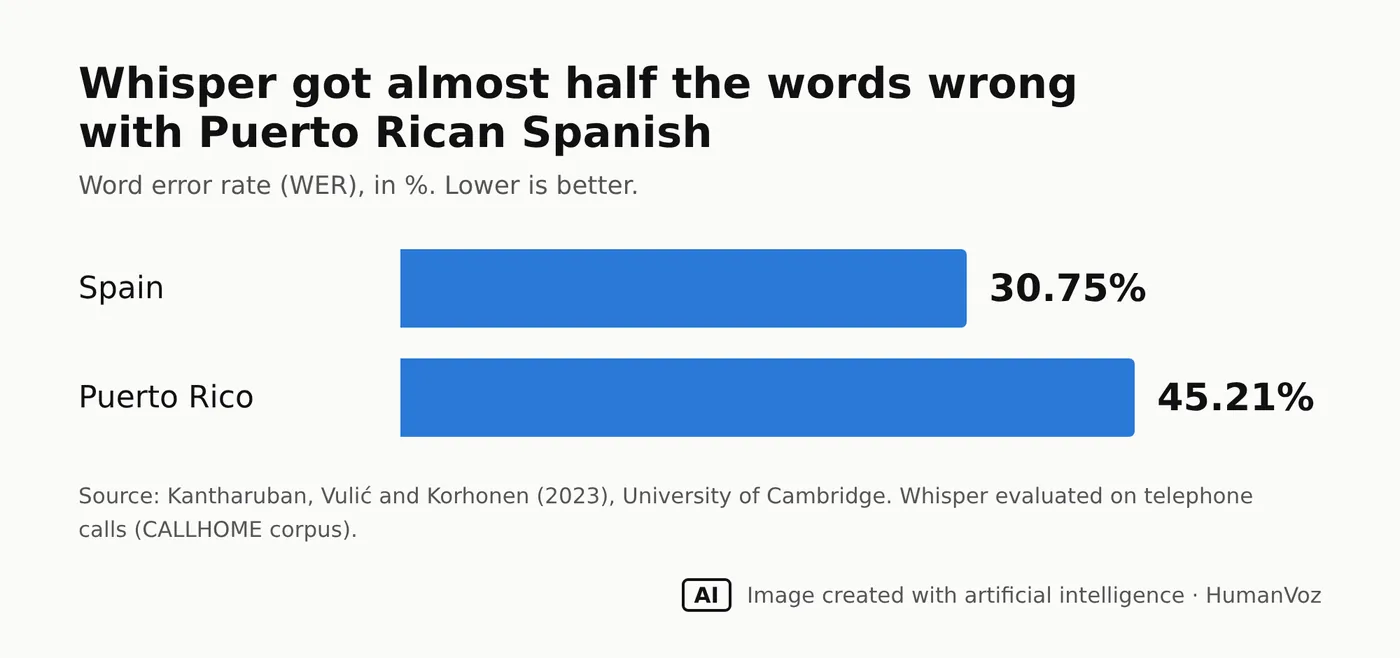
The word error rate, or WER, measures the substitutions, omissions and insertions found when an automatic transcription is compared with the words actually spoken.
Those figures come from one specific evaluation, with particular recordings and models. They don’t mean that every voice agent today makes errors at those rates.
But they do show that a system can perform very differently across varieties of the same language.
The study also found that the influence of the volume and composition of training data varies between models and languages. The authors concluded that there is no single solution that applies to every case.
In 2024, researchers at the University of La Laguna published Gender and Accent Biases in AI-Based Tools for Spanish: A Comparative Study between Alexa and Whisper.
Using recordings from the Mozilla Common Voice project, they studied how both systems recognised different varieties of Spanish.
They found performance differences between accents of up to about eight percentage points in some comparisons, including contrasts between the Spanish of northern and southern Spain.
They also analysed possible differences related to speakers’ gender. Although they observed variations, they did not consider them significant enough to conclude that the systems tested showed a relevant gender bias.
In 2026, researchers presented Dialect Bias in Speech Recognition Across 10 Spanish and French Varieties at Interspeech.
They evaluated seven models using about twenty hours of recordings from 129 speakers of ten national varieties of Spanish and French.
In Spanish, the Chilean variety had the highest error rates in the comparisons made. Dominican Spanish, on the other hand, did better than peninsular Spanish in some tests.
I’ve never been to Chile, but I’ve worked with Chileans, and speaking at the speed of the Flash, cutting words as if with a knife, swallowing or aspirating sounds, plus the wealth of idioms, not to mention the slang, make understanding them a challenge. What did surprise me was that the systems recognised Dominican Spanish better. I find Caribbean Spanish a little hard: they clip their words, and the rhythm is more merengue than bolero.
For example, this is how a Chilean might order a pizza from a voice agent:
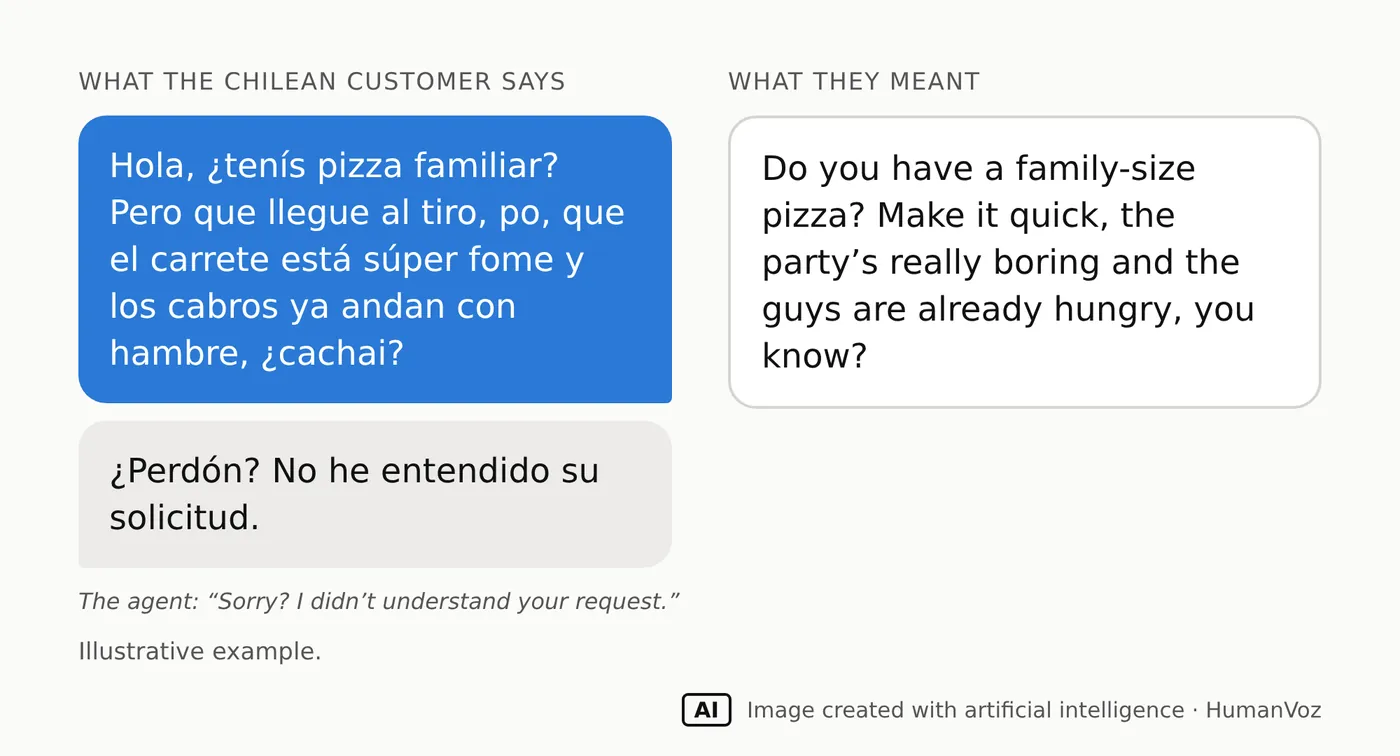
—Hola, ¿tenís pizza familiar? Pero que llegue al tiro, po, que el carrete está súper fome y los cabros ya andan con hambre, ¿cachai?
This, by the way, is what the Chilean speaker meant: Do you have a family-size pizza? Make it quick, the party’s really boring and the guys are already hungry, you know?
Back to the study: it is key to note that there is not necessarily a fixed hierarchy in which every system recognises European Spanish best.
The studies also observed errors related to grammatical constructions and regional expressions. Sometimes the system doesn’t just mishear a word: it changes what the speaker said to bring it closer to a more common phrasing.
When a machine corrects a legitimate language variety, it can lose information it should keep.
Size doesn’t guarantee representation or quality
Automatic speech recognition systems learn from recordings and transcriptions. How well they work depends on many factors: model architecture, training, audio quality, acoustic conditions and the characteristics of the data used.
Volume matters. It would be wrong to claim otherwise. But having thousands of hours of recordings does not, on its own, guarantee that those hours properly represent the users of an application.
Take a dataset of a thousand hours. If seven hundred come from a single variety of Spanish and the rest are spread across many regions, what can we conclude about its linguistic coverage?
Not much, without knowing how the speakers were selected, what each recording contains and how the system performs with different users.
The answer is not just in counting hours. It is in understanding what those hours contain.
Why should a company care?
Now imagine an insurance company that uses a voice agent to handle calls across Spain.
Its customers include speakers from different Spanish regions and people from many Latin American countries.
If the agent understands some users less well, the consequences could include misunderstood requests, longer conversations, transfers to human operators or abandoned calls.
All of this could affect the customer experience and raise operating costs.
This doesn’t mean every agent today has these problems. Many modern systems are trained on large amounts of diverse speech and can recognise many varieties well.
It means that linguistic coverage should be tested with the users the service is designed for, rather than taken for granted.
And that average performance doesn’t necessarily tell the whole story.
Listening and speaking: two different needs
A voice agent needs two capabilities that are worth telling apart.
The first is automatic speech recognition, ASR. It turns what a person says into information the system can process.
To develop or improve this capability, recordings of many speakers can be useful, with language varieties and conversational conditions that represent the intended use.
The second is text-to-speech, TTS. It generates the agent’s spoken reply.
Other factors come into play here: voice quality, consistency, pronunciation, rhythm, intonation, naturalness and expressiveness.
A dataset designed to recognise thousands of speakers does not necessarily meet the requirements of one meant to build an expressive synthetic voice.
Both work with the human voice. But their goals are different.
Linguistic diversity must also be designed
At HumanVoz we believe that producing voice data takes more than gathering speakers and piling up hours of recordings.
Before starting a project, there are essential questions:
Which Spanish does the system need to recognise? Who is going to use it? In what situations?
The answers should guide speaker selection, recording design, linguistic documentation and quality criteria.
They should also guide later evaluations. We cannot guarantee that a dataset will improve a system simply because it includes more varieties.
In Yemen nobody understood me, even though I spoke Arabic. I learned the local dialect with people who spoke it well and understood what I needed. Today many people experience something similar when they interact with AI. That is why at HumanVoz we use the voices of real people from each place, with their accent and their own identity. It matters that we all understand each other. And in the era we live in, “all” includes the machine too.
Sources
1. Scientific research
| Study | Link | Data we use |
|---|---|---|
| Quantifying the Dialect Gap and its Correlates Across Languages (2023), University of Cambridge | Publication · Full PDF | Differences in error rates between varieties of Spanish; relationship between data composition and performance |
| Gender and Accent Biases in AI-Based Tools for Spanish (2024), University of La Laguna | Full article · DOI | Comparison of Alexa and Whisper; differences between varieties of Spanish |
| Dialect Bias in Speech Recognition Across 10 Spanish and French Varieties (2026), Interspeech | Publication (DOI) | Evaluation of seven models; dialect differences and errors with regional expressions |
2. Datasets and original results
- Mozilla Common Voice — datasets: voice recordings contributed by volunteers. The La Laguna study used Spanish version 14, released in June 2023, which contained 2,175 recorded hours, 504 of them validated (MDPI).
- Zenodo — Alexa and Whisper results: the La Laguna researchers’ repository, with transcriptions, recognition results and error metrics broken down by accent and gender. It is especially useful for checking the figures we cite in the blog.
- Spanish and French dialect corpus — Interspeech 2026: record of the evaluation corpus used in the 2026 study: 1,223 minutes of speech from 129 participants. The audio is not publicly downloadable; access requires contacting the researchers.